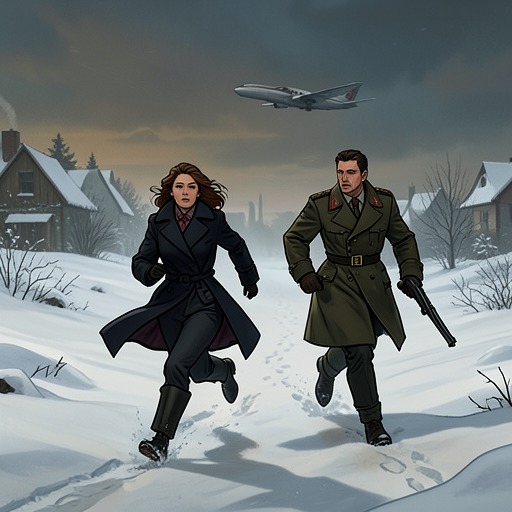
U.S. forces take Kristín and Steve to the glacier camp
Operation NapoleonU.S. forces take Kristín and Steve to the glacier camp after intercepting them on Vatnajökull and declaring the ice a prohibited military zone. The encounter turns their attempt to reach the glacier into a direct confrontation with the force Kristín believes is connected to her brother’s disappearance.
Interception and Prohibited Zone
Kristín and Steve had reached the glacier’s ice cap almost without noticing the change from snow-covered rock to ice. She stopped while Steve, lagging behind again, caught up; then lights appeared in the darkness, and four snowmobiles came straight toward them. They had expected the glacier to be watched, but not to be intercepted so quickly. There was no chance of outrunning the snowmobiles, and they did not try: Kristín reminded herself that people who needed to know had already been informed. Whether that warning would protect them was uncertain. As they waited, the cold became immediate and bodily; her feet, despite an extra pair of woollen socks lent by Jón, were turning numb.
The soldiers surrounded them on their snowmobiles. Their officer, like the other men, wore goggles and Arctic survival gear. He ordered the pair to turn back, explaining that they had entered a U.S. military prohibited zone where exercises were authorized and unauthorized personnel were barred. Kristín recognized the announcement not as a neutral boundary but as evidence: she suspected these were the soldiers her brother had seen, perhaps even the men who had thrown him into a crevasse. To her, their presence confirmed that his apparent accident concealed something the military wanted kept out of sight.
Violence and Recognition
The officer’s order met open defiance. Kristín snapped back, “Turn back yourself,” and seized his goggles, forcing him to meet her eyes. He jerked away; the goggles sprang back against his nose. Then he struck her in the face with the butt of his rifle, knocking her onto the ice. Steve lunged and grabbed him around the shoulders, but the officer drove the rifle butt into Steve’s stomach. Winded, Steve dropped to his knees. Kristín tried to rise, blood coming from her mouth and nose, but the officer pressed her down with his foot and repeated his command. The boundary he had announced as a military rule had become physical force against two people who refused to obey it.
Even on the ice, Kristín turned the encounter toward the person she believed stood behind it. Choking out the words, she told the officer to tell Ratoff that she wanted to meet him. The name startled him; he asked what she knew about Ratoff, betraying that he had said too much. Kristín smiled despite the cut on her lip. Her recognition had shifted the exchange: she was no longer merely a trespasser to be sent away, but someone whose knowledge made the officer pause and seek instructions.
He took out a mobile phone, made a call, and moved aside so Kristín could barely hear him. He reported that a man and a woman were there and that the woman knew Ratoff’s name. Returning to Kristín, he asked whether she was Kristín and whether she had a brother who had been on the glacier the previous day. She refused to supply the confirmation he sought, answering that he should tell her. The officer then acknowledged the instructions on the call, turned to his men, and announced that they were taking Kristín and Steve with them. The attempted entry thus ended not with the pair being turned back, but with their seizure by the soldiers whose presence had confirmed Kristín’s suspicions.
From Prohibition to Custody
The scene’s decisive change lies in the officer’s shift from invoking a public-sounding rule to acting on information received privately. His stated justification is that military exercises are permitted and the area closed to unauthorized visitors; the phone call, by contrast, turns on Kristín’s identity, her knowledge of Ratoff, and her brother’s presence on the glacier the previous day. The call is not audible to her in full, leaving the command behind the soldiers only partly disclosed. When the officer returns and orders his men to take the pair, the encounter has moved beyond exclusion: they are now in military custody, although the excerpt does not yet establish what will happen to them next.
The following dateline fixes the scene at Vatnajökull Glacier at midnight on Sunday, 31 January. That precise marker closes the interception on the threshold of a new stage: Kristín and Steve’s attempt to reach the ice has ended, and the soldiers who had presented themselves as guardians of a prohibited zone have become their captors.
Narrative Significance
The confrontation makes the glacier’s remoteness a condition of political exposure rather than refuge. Kristín and Steve cross onto the ice expecting surveillance, and their rapid interception confirms that the prohibited zone is actively guarded; the officer’s questions then show that the patrol is also responding to their identities and connections. The scene’s power comes from that narrowing gap between what Kristín suspects and what the soldiers’ conduct reveals: the force she associates with her brother’s disappearance is no longer an unseen presence but an armed authority confronting her on the ice. Her demand for Ratoff, delivered while injured, turns that recognition into a direct challenge, while the order to take the pair shifts the encounter from attempted exclusion to captivity.